
Have you noticed that being around people takes an incredible amount of energy? Especially in the last few years. It’s a skill we need to re-cultivate as the leaders in our homes, our classrooms, and workplaces. We need to help those we lead “people” again. I hear from teachers how students don’t know basic connection/friendship skills. I hear from parents how their children seem so distant from them. I hear from leaders in workplaces how getting employees engaged has been like pulling teeth. Coming from all kinds of spaces, leaders are sharing with me their people’s need to feel “safe”.
The truth is, if leave your house today and interact with others, you are far from “safe”. At some point in your day, you’re going to interact with someone who isn’t sensitive, who may gaslight you, offend you, gossip about you, or wound you – unintentionally or intentionally – especially as our social skills are lessening with more work from home, social media, and algorithms keeping us in our echo chambers of opinion.
To be with others is a risk today
I wonder if this is why we are seeing a rise in isolation? Covid brought us to our homes and gave us the opportunity to experience outside relationships on our terms. I can turn my screen off on the zoom call. I can engage from a distance. I can choose when I participate and when I won’t. I don’t know about you, but I used to go out all the time. Now it takes so much motivation to get out of the house. I’d rather be home. And when we don’t feel like “people-ing”, alone feels a lot easier.
The problem of “safe”
Just a disclaimer: I believe spaces need to be physically and psychologically safe for people to thrive. But today’s safe spaces seem to imply: YOU create for me the PERFECT environment, then I will be able to function. If you don’t, I may complain, I may languish, I may call in sick. I may disengage. Our definition of safe spaces has become a melding pot of potential offence. This creates disconnection, and a fear of others. We don’t want to accidently say something stupid or offend someone. The fear of not being what someone may need me to be makes me want to hide.
Here lies our problem. Humans mess up all the time. We need to come to our humanity with a level of humility.
I have been wounded in community.
But I have also wounded in community.
Most people don’t want to hurt others. We want to be good people.
The 0pportunity for a brave space
We are going to fumble around in our humanity, but here is our opportunity to gain a collective agreement of how we are going to work through the mess, and how we can turn towards one another when we want to run away. This is a brave space. It creates resilience and connection.
The number one foundation of a brave space is the concept of trust, which ironically leads to people feeling the safety they desire. In Steven Covey’s book, “Speed of Trust”, he states that environments which have high trust, move forward quicker, are creative, connection is easier, and they can get through anything together.
But if there’s low trust, it’s slow climb, people wonder why the environment is drowning in bullying, or spiraling into toxic cycles. People wonder why connection is hard.
I recently led a corporate non-profit in a brave activity of vulnerability. If I hadn’t built trust with the people, I would not have been able to lead them into such a brave space. Two of the ways I created trust was I gave them a choice of how they wanted to participate, putting them in the driver’s seat of their experience. Secondly, I gave them post it notes to share vulnerable feelings and thoughts with all the same color and same color pens to keep individuals anonymous.
The result? People went further into vulnerability than they thought they could as a team. It led to deeper connection. I’ve seen the same result in schools with a social experiment I did for over 20 years. It required bravery from the students, but they were in the drivers seat of their experience. This led to students with paralyzing anxiety being brave in front of their peers, shocking students and teachers alike.
I’ve seen brave spaces in action for over 20 years. It’s possible to create, but it will take trust. If you want to hear some ways to build trust, check out this episode of my Brave Podcast on Spotify, Apple, or YouTube.
To lead is risk
Here’s what I’m learning more than ever. To lead or love anyone else is a risk. We are not in control of how they will respond. We can either allow that to move us towards fear, leading to reacting to everyone around us, building walls around our hearts, and keeping our armour on…
OR
We can risk to be brave. We can lean in when we want to run away. We can dare bring down the drawbridge along the walls of our heart. We can risk on people, knowing they will fail us, but when that happens, we can manage ourselves and decide how to respond in a loving, yet boundary-full way.
A safe person can create a place where people can be brave that is safe.
The leader goes first.
Whether you’re a parent, teacher, or leader of a group, keep being brave.
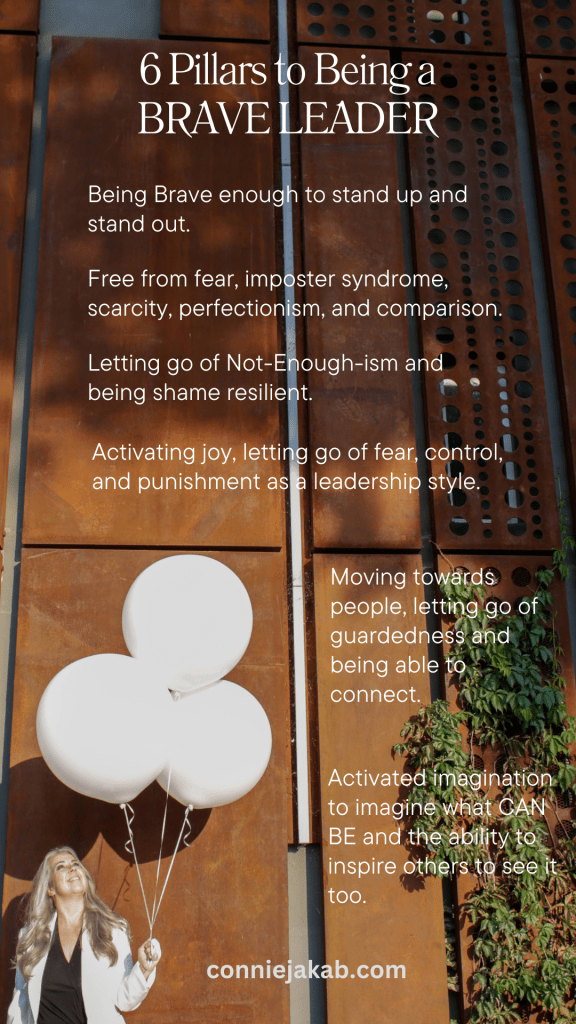
These are the 6 pillars I’ve noticed in a brave leader who is able to create these brave spaces I’m talking about. I’m going to be giving away secrets as to HOW to do this in my Find Your Inner Brave Webinar on April 15, 2024 at 6pm MST. I can’t wait to share my secrets with you or anyone on your team.
This is perfect for you if you lead a team of any kind, if you’re a teacher, or a parent. You can register free by clicking here.

 Bravely Connected
Leave a comment